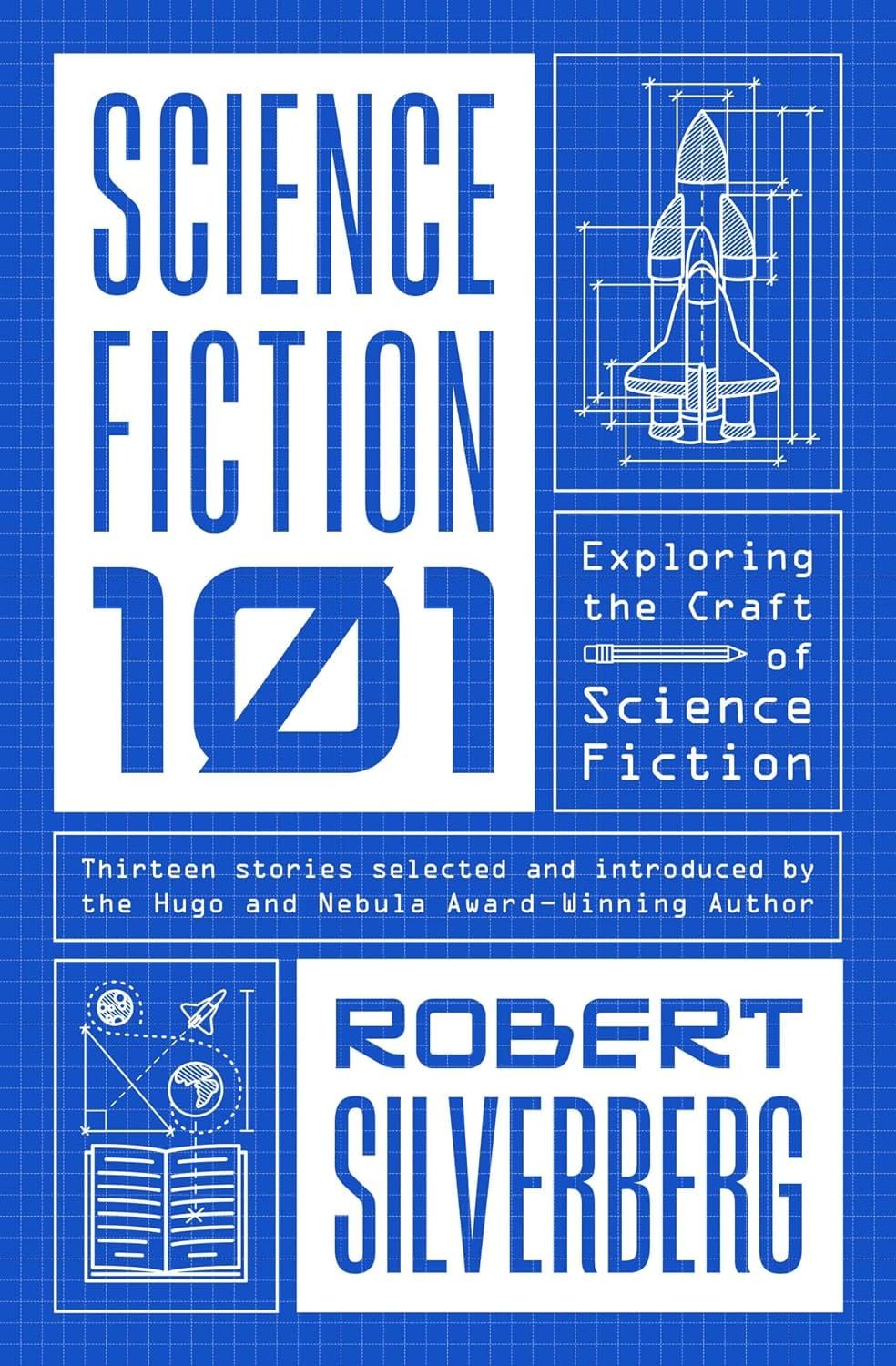
Science Fiction 101 - Robert Silverburg
A grandmaster reminisces on his childhood and teaches you how to pick apart stories for their meaty writing lessons.
Tone: A master reminisces on his childhood and teaches you how to pick apart stories for their meaty writing lessons.
What: Stand-out short stories and accompanying essays that pick them apart for lessons on writing.
Who: Robert Silverburg is a Grandmaster of Science Fiction, a member of the Science Fiction Hall of Fame, and had attended every single Hugo award ceremony from 1953 (the first one) until 2015. A complete list of his collected works would stretch to over 500 books including novels, short fiction collections, edited anthologies, and nonfiction.
When: For writing better short stories and reading like an author.
% On Topic: Medium
When I was about thirteen, I discovered in the depths of a Vroman’s bargain bin a very large book with the promising title: Science Fiction 101. Well that’s clearly a book meant for me, I thought. I had only recently decided that writing was something I’d like to do and this book came with the byline “Where to start reading and writing science fiction.” Perfect.
I think I finished it in a day. Then I re-read it again. And again.
The book was great for two reasons. One it introduced me to some of my favorite science fiction short stories. And two, Silverberg's essays after each story dissecting what the story had taught him about writing and pointing out things that the writers did extremely well. He does this from two perspectives, what each story had been to his teenage self and what it was still teaching him after thirty-five years of writing.
In the introduction he comments:
“The process of becoming a writer involves discovering how to use the accumulated wisdom of our guild, all those tricks of the storytelling trade that have evolved around the campfire over the last five or ten or fifty thousand years. Others can show you what those tricks are. But only you can make a writer out of yourself, by reading, by studying what you have read, and above all writing.”
Some of the advice which seems obvious now I remember being eye opening in middle school. The “Purpose, Passion, Perception” structure, which he attributes to Kenneth Burke’s “The Tactics of Motivation,” I remember making a particular impression. The idea is that all stories have what Burke called “the tragic rhythm” – an underlying structure which builds drama and holds the story together. It begins with Purpose – the goal of the characters – both the protagonist and antagonist. Passion is the struggle of those characters to attain their goals against whatever obstacles stand in their way. Perception then is the culmination of the story; the outcome of the passion of the characters which Silverberg also notes should come with some fundamental change in the character of the protagonist. The bigger the change he notes, the better the emotional impact of the change.
Other tidbits I’m still wrestling with decades later. For instance:
“…[H.D.F. Kitto] taught me what a dramatic situation really is: a zone of inevitable opposition of powerful forces that emits ever-widening reverberations until it is neutralized somehow in a way that creates understanding, insight, and harmony. Knowing that, I could work backward from my perception of the story’s central issue to generate its plot. What created this conflict? What can possibly solve it? Who is being hurt by it, and why?”
Sounds simple to do. Just come up with your story’s central issue before you begin and then ask yourself those questions. But its a pain in the butt to do in practice and maintain across even a short story. I expect I'll struggle with it the rest of my life.
Science Fiction 101, or Worlds of Wonder as it was originally titled, would be worth reading for simply for the collection of short stories. Thirteen in all, they are still some of the most delightful, most impactful, science fiction short stories I’ve ever read. Each one has that sticky quality of memory that finds you contemplating their themes and consequences in the small hours of the night when you should be sleeping. Or popping into your mind at the oddest moments. Taken together with the commentary, they have so much to teach. Well over two decades later, I’m still learning new things every time I reread them.
I would be remiss in noting that not everything about the book has aged well. Silverberg gives only one story in thirteen to a female writer (C. L. Moore) and reveals her gender like the surprise I’m sure it was to him at one time. The reader/future writer is referred to with male pronouns throughout the essays. And the stories, well they were written mostly in the 50’s and early 60’s. In fairness, Silverberg does call the authors out on their underdeveloped female characters (except when he’s pointing out stories in which all the characters are underdeveloped because developing them would undermine the tension of the plot, see "Four-in-One"). The inclusion of “Day Million” by Frederick Pohl, in which the characters are neither male or female or “anything you would recognize", is enough of a palate cleanser to make the rest tolerable for me. But if that's a deal-breaker for you, this isn't your book.
If you are looking to write science fiction, or you are looking to learn how to analyze a short story for the clockwork bits that make it tick, this is still the best place to start.
If you would like to to view a purchase page for this book, please consider using this affiliate link to bookshop.org to support your local independent bookshop and this site.
*A version of this review was published in 2017 on my first website.