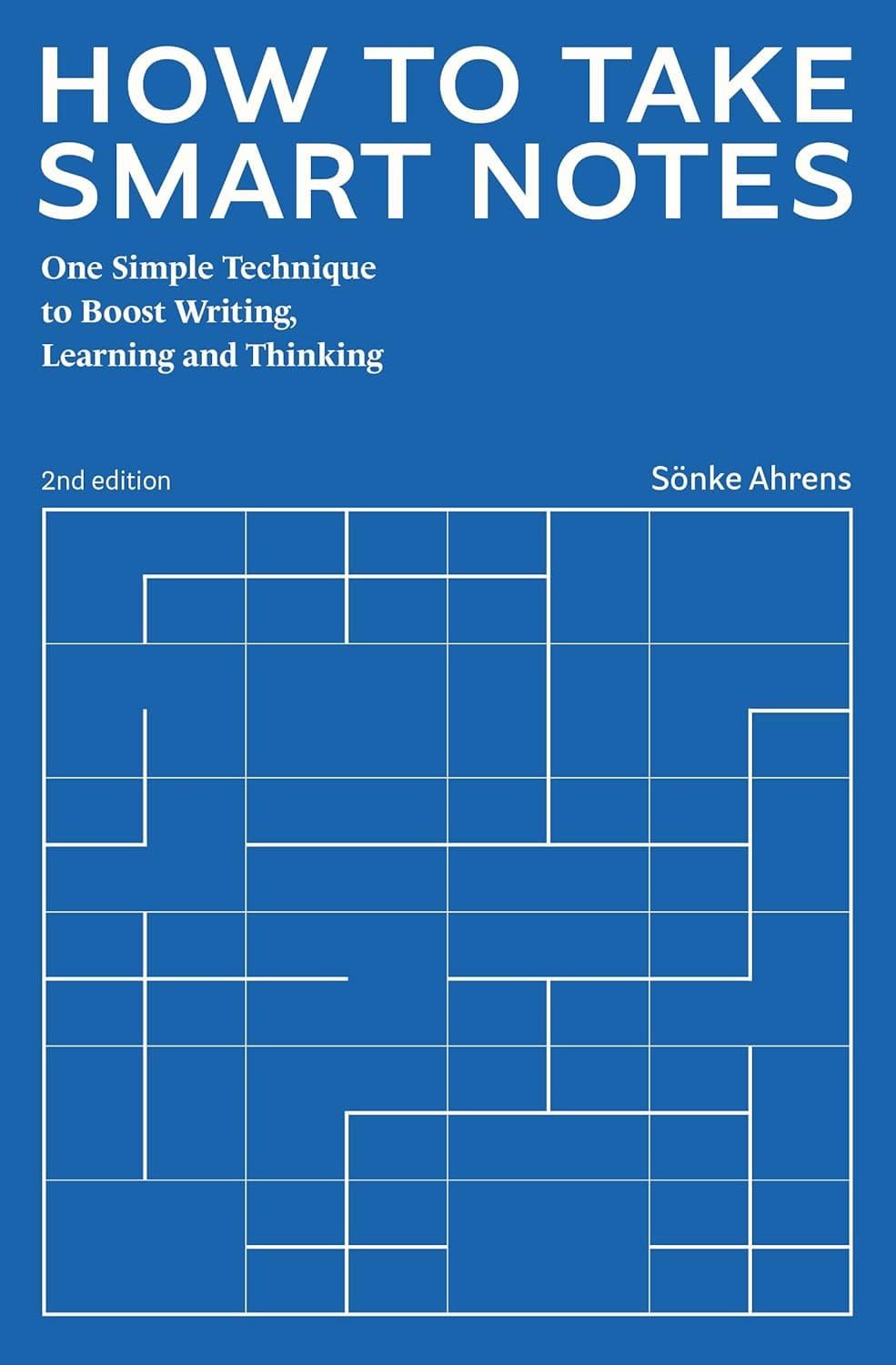
How to Take Smart Notes - Sönke Ahrens
If you are doing any kind of reasearch How to Take Smart Notes is worth a read to see if these ideas work for you
Tone - A brilliant, slightly obsessed professor talks about his favorite topic at the pub; relaxed and informative if you can get past the repitition and loose structure
What - instructions for building and using a zettlekasten or slip-box system for organizing research and writing.
Who - for students, academics, and nonfiction writers primarily but it may be useful for others
Read it When - you need to build a research bank on a topic in a quick and organized manner that will spark natural questions
% on Topic - Medium to High with a few digressions into history and the science of learning.
It feels like a lifetime since I posted my Books for Nonfiction Writers list, but it has only been a few weeks. In that article I said "This book will change how you think about writing papers." And that is certainly true, although to what extent will depend on your field and your willingness to experiment. But after a few weeks to settle and play with the system, I think it has changed the way I fundamentally connect information in my head, and that is very very cool.
While Ahrens is the author of this book, the idea of a Zettlekasten, or Slip Box, really started with the German scientist Niklas Luhmann in the 1960's, whose unique system of note taking helped him become one of the most prolific scientific thinkers and writers of the 20th century. Ahrens sets out to describe this system in some detail, and then gives arguments for adopting this method, with examples.
The original Zettlekasten was two plain wooden boxes of essentially index cards, one a "bibliography", with short notes on every article you read, and the other the "ideas box" containing a networked series of ideas, topics, and questions to presume. The original system involved a code to connect the ideas so they could be reconnected to each other in the future, but today's methods rely on simple hyperlinks.
Ahrens is very clear that the idea is not to form a collection of thought or an archive, but a network that encourages creative connections between nodes. Topics should be areas of your own interest, not just what is in the articles, they should be specific to you and require thought to make the connection. Ultimately the goal is to give you a system that sparks insights, creates research areas, and builds evidence for theories before they are even fully formed. Thinking, as he says many times throughout the book, is the main work. Everything is in support of generating and supporting networks of thought.
Ahrens also fills this text with lots of references to the science of learning (which makes sense as he is an Education researcher). He also gives examples of how to use the zettlekasten to build a research paper, though actual examples of working directly with the method are a little thin. That said, it seems to be a system you need to build for yourself so maybe those examples wouldn't be as useful as I think. Still, I felt the lack of concrete examples of actually using the method in the text.
Personally, I took his recomendation to use the technique with the notaking site Obsidian and ran with it. That has been working very well for me. There is a lot online about using Obsidian for writing, or as a zettlekasten if that's of interest to you. This book certainly has enough to get you started if that's what you are going for, but you could easily also do a bunch of reading online if all you want is some organizational ideas.
This book will either rock your world or leave you a little cold, depending on if you can see the relevance of the system to your own work. If you are doing any kind of reasearch it's worth a read just to see if the idea works for you.

If you'd like to buy this book based on this review, please consider using this affiliate link here to help support the site.