Fake Query Letters by Dead Authors - Brown & Barker
Five dead authors query their familiar novels, in this short but intense introduction to the query process.
Tone - relaxed and chatty, like a good workshop, on topic but having fun with it
What - The editors of the Darling Axe blog craft fake queries for well known novels
Who - David Grifin Brown and Michelle Barker are the senior editors at Darling Axe, a writing craft website that hosts pitch competitions and literary agent interviews.
Read it When - Authors who have a completed manuscript and are thinking of starting to query.
% on Topic - High
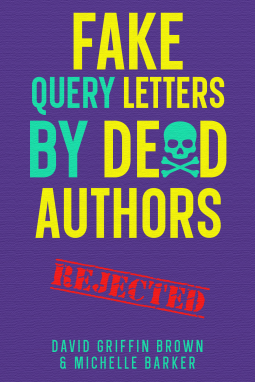
Sometimes it’s a book’s cover that catches your eye. Sometimes it’s the name. Sometimes it’s the authors. And sometimes all three jump out at you one after another like a particularly aggressive trio of salesmen. Fake Query Letters by Dead Authors is a great name, and the purple, yellow, and teal of the cover is particularly eye catching against the mostly browns, reds and blues of other writing books (I might need to get a physical copy just so I can finally complete a rainbow gradient on my cover images). I didn't know David Grifin Brown and Michelle Barker by name, but I did know of DarlingAxe.com, a website which offers freelance editing services, but also runs an excellent craft blog and query contests. They have two other craft books as well Immersion and Emotion and Story Skeleton.
Fake Query Letters gets right to business after a short introduction, with the query letters. The conceit of this book asks "What would the query letters for famous novels look like if they were written today?" And its a pretty good one, letting the authors focus on the details of the queries and not on the plots of the novels. Brown and Barker start with a flawed query letter for each novel, then do a short critique of the letter, followed by a rewrite with all the critique incorporated.
The novels they work with should be familiar to folks subjected to any high school English classes. They are: Pride and Prejudice, Wuthering Heights, The Scarlet Letter, Anne of Green Gables, and Jane Eyre. The authors do a great job of summarizing each one, in case you missed that book (or maybe forgot the plot). And the familiarity of the stories helps in understanding their explanations of why the first query doesn’t hit, and what the “author” can do to fix that.
They then move to sample synopses and first pages following the same model. The “flawed” versions are all just absurd enough to drive their points home, and the critique is gentle but instructive in each case. You might even notice a few new things about these classics that you missed when reading them in school (and make them hard to publish today). Still, fifteen of these was just about my tolerance level for the conceit, and some of the advice gets a little repetitive. Not excessively so, more I think to drive certain points home.
The fourth section takes up the back half of the book and it is a no-nonsense crash course on getting your own query, synopsis, and pitch written, complete with template and advice on customizing for agents. As the authors say at the beginning of the section.
““Follow instructions” might sound like such a simple rule that it’s not worth mentioning, but a surprising number of people do not follow agents’ instructions, and, as a result, their submission goes straight to the bin.” p.99
In quick, to the point mini chapters, this section covers:
- What is the query process
- How to write a query letter
- How to write a pitch
- How to write a synopsis
- The importance of Voice
- How to keep things moving in the opening
- How to write a gripping first chapter
- To prologue or not to prologue
- On alpha and beta readers
- Querying strategically
- Pros and cons of agents vs. self publishing
- Dealing with rejection
- What to do when you get a full request
- What happens next
There’s a lot of information packed into a fairly short read here, but all of it is good and littered with anecdotes from their Book Broker agent interviews like:
“A pitch should convey two basic things: you know how to write, and you’ve got one hell of an idea. As literary agent Sarah Davies puts it, “I’m always looking for the two C words—concept and craft.” Not confusion. Not chaos.” p.106
The book finishes out with an extremely helpful resource review on the most common resources used to help find an agent. It’s not long, but it covers the basics to get you started in the right direction. And it’s nice of them to mention that there are tools available, which newer writers might miss if they don’t have a community of writers to compare notes with. The second appendix describes their own publishing journeys, again a nice to have when you may not have heard how it goes yet.
If you only read this book on querying you would be in a good place to get started. If you followed their advice to the letter you might even be in a very good place. Querying is hard, and there is no guarantee. But this book is a fun read to get you started. Combine with reading some of the agent interviews on Darling Axe and you’ll be doing better than most. As Brown and Barker say in their conclusion:
“There are many guides out there with advice on how to write great query letters and how to effectively target the right agents, but the single most important step is to refine your narrative and polish your prose until your manuscript stands out among that top two percent of submissions that make an agent intrigued, then interested, then eager and excited to work with you.” p. 176
If you are getting ready to query, or are wondering what the query process is like, this is a great place to start. And if you’ve been in the trenches a while, seeing bad examples and good might give you a few new pointers as well.
If you'd like to buy this book based on this review, please consider purchasing it on the author's website instead of Amazon.