Manipulating sentence structure
A guest post on syntax by Jordan Jones of Red Pens and Playwriting.
A guest post by Red Pens and Playwriting's Jordon Jones
Salutations to you all!
This is not your usual writing guru speaking; Emily has very kindly allowed me a slot to talk about something very near and dear to my heart: syntax. I know, it doesn't sound all that exciting, does it? Not compared to things like story arcs and characterisation and worldbuilding and literary techniques, certainly. It's easy for us to want to devote time and effort to examining the fun elements of storytelling, but it's also important to remember that telling stories is, first and foremost, a type of communication. Whatever story we want to tell, in whatever manner we tell it, will greatly benefit from being communicated effectively through things like grammar and syntax. Our artistic medium is words, and we need to be as competent with them as a visual artist needs to be with lines and circles.
For anyone who isn't completely sure what "syntax" is, I will define it here as the way that words are arranged in sentences. It includes things like how long a sentence is, the number of clauses it contains, whether it is a grammatically correct sentence at all, and the order in which information is presented. There's a lot more to it than just correctness—you can use your understanding of syntax to influence the way your reader experiences the text. In fact, you're probably doing this already!
Let's explore a few ways that this influence takes place. For best results, pull up a piece of your own writing to refer to as we go and see what you notice. How does the syntax of your writing affect the way it reads? Where are you purposely playing with it to affect the reader? Are there opportunities where you can alter your sentence structure to improve the text?
Manipulating length
One method of syntactical manipulation that is easy to spot is sentence length. This is related to complexity, because longer sentences can fit more complications in them, but it's not a 1:1 correlation, so I'll discuss them separately. The main effects of length, in particular, are rhythm and pacing. Here are a couple of examples to compare:
Maria's heart was hammering in her chest as she approached the forbidding door to the chalet. The handle of the battered suitcase she held felt slick and clammy with sweat, slipping easily from her grasp with a thud. Slowly, reluctantly, she raised a trembling hand to the knocker.
Maria stood before the chalet door. Her heart hammered against her chest. Sweat coated the handle of her battered suitcase. It slipped from her hand with a thud. Slowly, she raised her hand to knock.
You can see the difference in rhythm pretty clearly here: with the first set of sentences (probably an average length for most people, and certainly normal for me), there's a smoother flow, whereas the shorter sentences create a choppier effect. You can use this manipulation of rhythm to adjust tension—doesn't that second example feel so much more anxious, even without the visuals from the adjectives? A single short sentence can also be a good way to punctuate or interrupt your flow to draw attention to a particular beat. Like so. On the other end of the spectrum, check out this much longer sentence:
With her heart hammering in her chest and her battered suitcase slipping in her clammy, sweat-drenched hands, Maria approached the forbidding door to the chalet, at which point the suitcase finally dropped to the ground with a thud, leaving her hand free to reluctantly creep up towards the door knocker.
We've gone beyond having a comfortable flow here, and it feels more like we're skimming across the action than like we're engaging with it. This could be a useful way to convey a sense of too much happening at once or of emotional overwhelm, where there isn't a chance to pay much attention to the details. Too many excessively long sentences can lose a reader's attention, though, so be careful with them.
Pacing is essentially rhythm on a larger scale, looking at full scenes rather than individual sentences and paragraphs. Within the scene, you'll want your sentence rhythm to expand and contract along with the emotional beats, but when you zoom out a bit you will probably notice that most of the sentences tend towards being longer or shorter, and that's a big part of the pace. Scenes with lots of quite long sentences feel less urgent, perhaps more thoughtful or introspective. When you put more short sentences together, the scene feels more focused, like a climax or action sequence.
Manipulating complexity
As I said, sentence complexity ties in pretty closely with length, as complex sentences are often long as well. However, the effects of complexity don't necessarily relate to those of length, even if they do like to exacerbate each other.
Before we get any further, I want to provide a few definitions to help with this next bit:
- Clause: a collection of words and phrases containing both a noun and a verb—if it can work as a full sentence, it is an independent clause, otherwise it is a dependent one
- Simple sentence: a sentence containing only one independent clause
- Complex sentence: a sentence containing an independent clause and at least one dependent clause
- Compound sentence: a sentence containing more than one independent clause (if there are also dependent clauses, that makes a complex-compound sentence)
Now that we have that sorted, what are the effects of complexity in sentences? Clarity, mainly. Simple sentences are very straightforward, and don't tend to have a lot of fluff to them ("Maria stood before the chalet door."). Complex and compound sentences add more context to the sentence, and the reader starts to make inferences from the way clauses are connected ("Maria's heart was hammering in her chest as she approached the forbidding door to the chalet." Ah, something about the chalet is making her nervous!). The more connections between different clauses the reader has to draw in one sentence, the greater the chance that something gets missed or misunderstood.
I find myself constantly breaking up and simplifying sentences in my own work, because while I think all of the context and connections together at once, I've learned that that is not a great way to communicate. Readers, including me, need to make connections one or a few at a time, not in a great lump. Think about which pieces of information have the strongest links to each other; these can be joined in a complex sentence, such as the chalet affecting Maria's heartbeat. Points which are closely tied to each other but are more distinct or complicated might be better in a compound sentence, such as "Sweat coated the handle of her battered suitcase, and it slipped from her hand with a thud." If the information is not strongly connected to anything else, or if you really want it to stand out, put in a simple sentence.
The complexity of your sentence structure also contributes quite strongly to voice, whether in relation to narration or character dialogue. If you struggle with creating distinct character voices, one thing that may help is looking at how they structure their language. A preference for simple sentences might indicate a focused or taciturn nature, where the character speaks right to the point. They might also be used for a child or non-fluent speaker, who might not have developed the language skills for more complicated speech. Conversely, characters who use a lot of complex and compound sentence constructions are often read as being more studious, analytical, talkative, or maybe just really neurodivergent.
Manipulating order
The last element of syntax I want to talk about today is word order. This is something that I suspect a lot of writers don't think very hard about unless they have a history of writing in verse. As a matter of fact, absorbing Shakespeare's technique of playing with phrasing and writing sonnets in his style was a great way for me to explore ways of manipulating the way that a sentence or phrase is ordered. In the context of sonnets you have to order words to fit the rhyme scheme and metre; you don't need to worry about those elements so much in prose writing, but there are other ways in which word order makes a big difference.
I read a fantastic article at university called "The Science of Scientific Writing", by George D Gopen and Judith A Swan, which completely revolutionised the way I think about sentence structure. Their article is primarily aimed at scholars in STEM subjects trying to communicate their research, but I think their concepts can be applicable in any form where you're trying to convey potentially complex information, from business emails to worldbuilding exposition. The whole article is great, but the particular ideas I want to point out here are the two ends of a sentence: the topic position and stress position.
The topic position in a sentence is its beginning, and this is your chance to make sure your reader is prepared for the rest of the sentence. It's where you generally introduce the sentence's subject, along with whatever context you need to get out of the way. You may also link back to the previous sentence to keep up the momentum of the piece. In simple terms, the topic position introduces the idea and sets the reader up. Compare the following, and note a) which is easier to follow, and b) what the focus of each sentence seems to be:
Before the war, I lived in a castle overlooking the river with my uncle.
A castle overlooking the river is where, before the war, I lived with my uncle.
The other end of a sentence is called the stress position, and that's the bit that readers will emphasise and remember most. This is where you want to give your reader closure to the idea that you introduced and tie things off, but also where you want your most important or effective takeaway to be, whether that's a piece of information or an emotional effect. The last thing we read is what sticks in our heads, so you want to make it good. Here are a couple more examples to illustrate the idea:
"I understand your problem, but I don't care," said the general with a flick of his cigar.
"I understand your problem," said the general with a flick of his cigar, "but I don't care."
This idea of topic and stress positions isn't just confined to sentences, either; you can use it to organise sentences within a paragraph as well, or to order concurrent POVs in a section of a novel. You just need to think about two things: what does the reader need to know first, and what do you want to leave them with before you move on?
Red Pens and Playwriting is a blog for writers of all levels of experience that discusses a variety of topics relating to language and literature. It is written by Jordon (Jojo) Jones, who has a distinct passion for the technical craft of writing and constantly insists that knowing the rules is important because it enables you to break them on purpose.
Shh... Jordan doesn't know I'm putting this here.
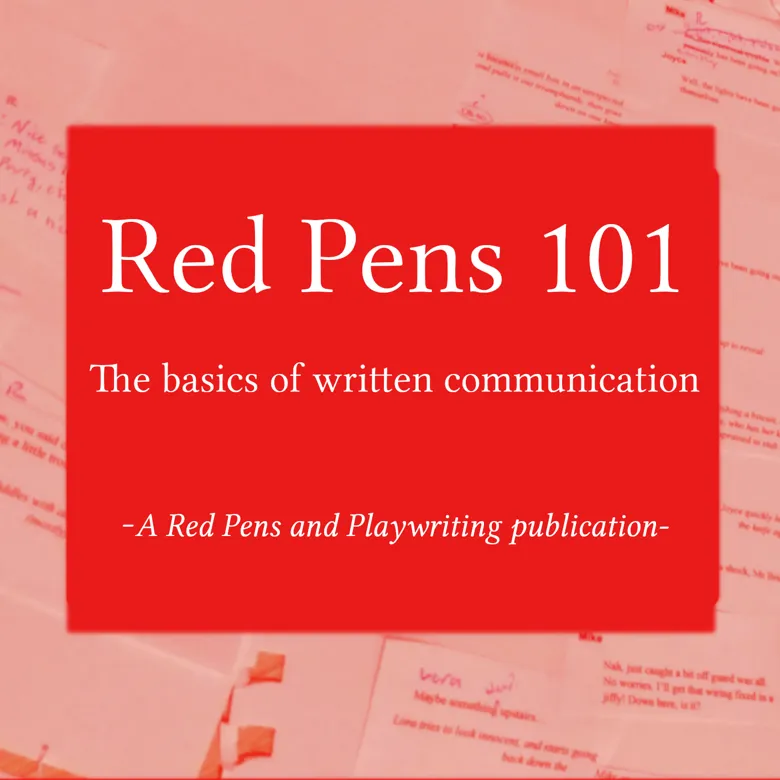
Jordan just published an excellent manual called Red Pens 101 on the basics of grammar with heaps of examples, a lot of cat references, key point summaries at the end of each section, and one rickroll. Take a look. ~EM
~~~
Image Credit: Via Library of Congress. Albrecht Durer "St. Anthony (1519) Engraving B 58. From the Impression in the British Museum." in Eckenstein, Lina, Howard Coppuck Levis, and Lessing J. Rosenwald Reference Collection Dlc. Albrecht Dürer, / by Lina Eckenstein. , 1902. [London, Duckworth & co] Photograph. https://www.loc.gov/item/03016535/. Image cropped and converted to black and white.