What to do when your writing doesn't match your idea
Advice for when the writing isn't what you want it to be, but you're not sure how to move forward.
We all have moments when we look at our work and are dissatisfied. The writing simply does not match what you had in your head. Mostly I think this is a good sign of a growing awareness of your own writing. You see the potential for the writing to be better. But it is also possible to get stuck in this place where the writing isn't what you want it to be, but you're not sure how to move forward. So here are some ways to cope when your output does not match your idea.
Recognize that you are in the "Gap"
There is a famous Ira Glass quote, which this term comes from. I'll quote the whole thing below, but I really like this youtube video which includes the audio from the interview the quote comes from:
“Nobody tells this to people who are beginners, I wish someone told me. All of us who do creative work, we get into it because we have good taste. But there is this gap. For the first couple years you make stuff, it’s just not that good. It’s trying to be good, it has potential, but it’s not. But your taste, the thing that got you into the game, is still killer. And your taste is why your work disappoints you. A lot of people never get past this phase, they quit. Most people I know who do interesting, creative work went through years of this. We know our work doesn’t have this special thing that we want it to have. We all go through this. And if you are just starting out or you are still in this phase, you gotta know its normal and the most important thing you can do is do a lot of work.”
― Ira Glass
So, step one is to realize that you are experienceing the gap, and that means you are right where you need to be.
Allow your draft to be bad
This is the next big one. Drafts, even second and third and fifty-second drafts are allowed to be bad. There are no writing police who will arrest you for writing bad prose. No group for the preservation of the language who will accost you for your assault on the language. That is simply not a thing. One of the best pieces of advice I've ever gotten is to allow the work to be bad and accept that it will improve over time. You are allowed to write bad drafts in persuit of good writing.
Give your draft some space and time
If you have the ability, take a step away from your work and give it time to breathe. The longer the work, the longer it typically needs for you to find a better headspace and come to it with fresh eyes and a new perspective. If at all possible, let your draft sit and come back to it after an hour, a day, a month, however long it takes for you to gain some distance. You might be surprised when you return to it and find that some of its flaws no longer loom so large in your mind.
Another way to get space is to literally change the way you are reading your document. If you usually work on a computer, try putting your draft on your kindle for a bit. Or, if you are having trouble being too serious about your work, try putting it in a silly font for a while. Bubble letters, comic sans, heck go bold and try papyrus. Anything you can do to recontextualize the text so your brain is forced to see it as something new can be helpful.
Evaluate what's missing
Once you have some space, read your work with a critical eye, as if it were the work of another person, and see if you can spot what it is missing. This is an essential skill for a writer, to be able to read your work as a reader will. Being able to articulate what you think the issues with your own manuscript are is the first step to fixing them. If you are having trouble with this, it might be a good time to ask a (compassionate, thoughtful) friend to look at your work and let you know what is not working for them. But in all likelyhood, you have a gut feeling for what isn't working.
Whatever isn't working, take the time to do some deliberate practice and reading on that topic. Maybe do a full master study on a work that you think does that particularly well. But step away from the work, spend some time doing whatever research, or practice, or study you think you need to do, and then come back to it. It is also important to make the attempt to fix the problems you see, even if you are not always successful.
Make, Fail, Make, Fail, Make
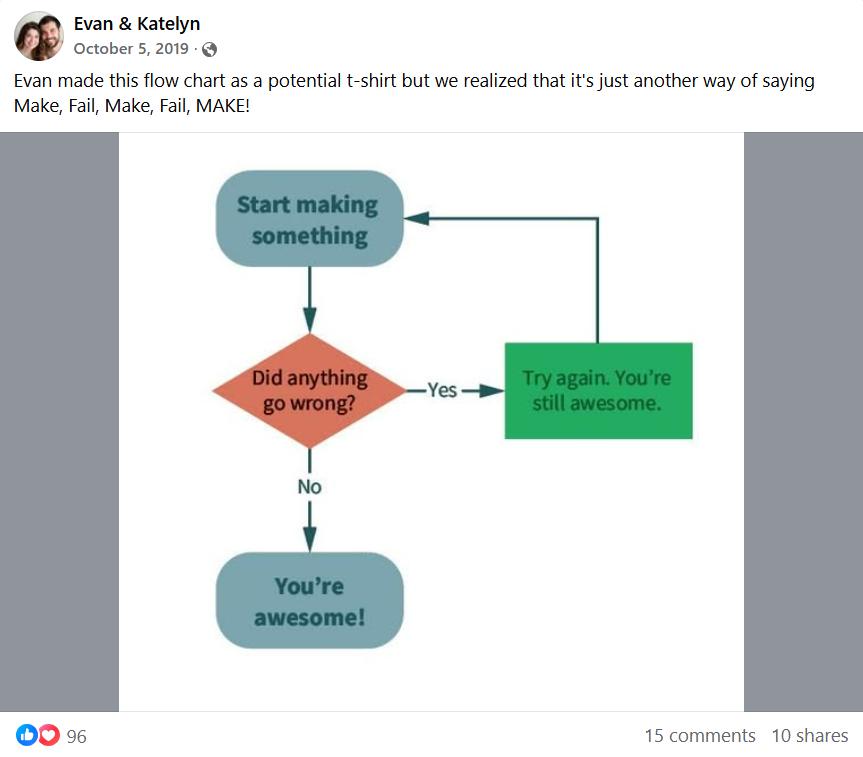
This is a mantra from the maker community, popularized by Evan and Katlyn on YouTube (go watch their Catcus cat house video when you are done here). It is a good reminder to accept that mistakes and re-doing things are an essential part of the process of making things. Even successful, experienced people still encounter failure, it doesn't mean you are a failure, it just means you're still working.
So, what are you struggling with right now? Let me know in the comments and I will commiserate as I struggle throough my revisions this week.