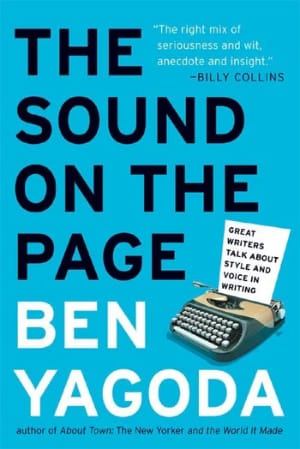
The Sound on the Page - Ben Yagoda
Ben Yagoda strives to understand voice and style through reasearch and over 40 interviews.
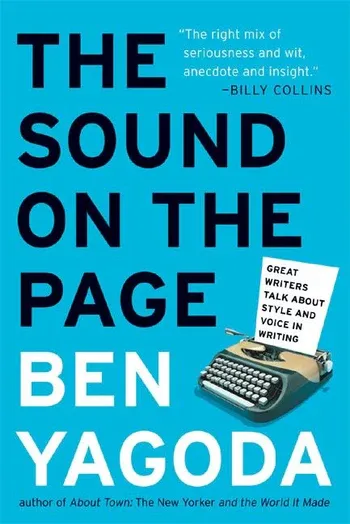
What: Journalist Ben Yagoda interviews 40 writers and quotes dozens more on the topic of style and voice in their writing.
Tone: Somewhere between name-dropping pop-journalism and a quote-happy literature professor
Read it When: You are interested in what many famous writers have to say about developing a style. You want to put in some serious work to develop your own writing voice.
% on Topic: Medium
Ben Yagoda is an American journalist and English professor who worked as a freelance writer for the New Yorker, New York Times, Rolling Stone, and Newsweek. He has written several writing books including Gobsmaked! The British Invasion of American English and How to Not Write Bad: The Most Common Writing Problems and How to Avoid Them as well as several pop-histories and a few journalism textbooks.
In The Sound on the Page Yagoda leveraged his journalistic connections to interview more than 40 writers on the subject of style and voice. Which makes it a unique read because of the density of quotes on the subject of style from many well known writers. While ultimately I'm not sure he achieves as thorough an explanation of how to build one’s own voice as I would have liked, he certainly gathered some impressive research on the topic.
The opening chapters of The Sound on the Page delve into the history and development of “style” as a literary phenomena, especially in literary works. Yagoda establishes that popular author’s styles both shape and are shaped by the public’s shifting taste in text. That taste has shifted over time from the extreme verbosity of the late 1800’s to the extremely spare style of Hemingway in the early 1900’s, to what he calls today’s “middle style” which balances functional prose with the aesthetic.
He spends a good chunk of the book cataloging various styles whether in a “field guide” of styles or in a long section of styles according to the form of writing, from “clear” instructional text to verbose and obscure poetry. He touches on how writers begin to read for style, and how style can reflect an author’s personality or be completely contra to their in-person persona. Throughout it all the text is larded with a profusion of quotes, some from written works and many from the interviews he performed.
There are too many quotes to, ahem, quote specifically, but some of the more interesting to me were the writers who compared style to fashion, and that you might develop your own style by first imitating others.
John Lukacs says: “I’m convinced that style is like taste. That is a very interesting thing, because taste itself, the very existence of taste, denies Descartes’s division of the world into subject and object. If style were purely subjective, then it would be deterministic: I write this way because it’s the way I am—I cannot do otherwise. But that’s not true. Style and taste are also a matter of participation, of deciding what one will like and how one will write. Style begins the way fashion begins: somebody admires how the other man dresses and adapts it for himself.” p. 362
The Sound on the Page is not a book of exercises, though there are a few suggested near the end of the book. Yagoda recommends reading widely and aloud to “train the ear to pick up the strains of other writers’ styles” p. 347. Indeed earlier in the book he recommends reading your own work aloud as one of the best pieces of advice from his teaching career. One suggested exercise based on the teaching of the writer Erasmus was to rework the sentence “your letter has delighted me very much” or a similar sentence into as many various as possible (Erasmus claimed to have written 150) p.359.
Another involves writing a short piece and then taking it to as many extremes as you can, which is similar to an exercise in Le Guin’s Steering the Craft:
“Once you’ve got your page down, transform it, over the course of a week or so. Specifically, take it to extremes, in multiple versions. Try it with no contractions and with contractions at every possible opportunity; with short sentences and complex ones; with one-sentence paragraphs and all in one paragraph; with short Anglo-Saxon words and with long Latinate ones; with literal, straightforward language and with as many metaphors, similes, and rhetorical questions, as much irony and hyperbole and alliteration, as you can pack in. Then experiment a little with compression and slackness. Do one version that’s as long as you can reasonably make it and another that’s as short as possible, each time trying to impart the same sense.”
When you’re done, you’ll have a lot of really bad stuff. But you’ll also have some useful lessons, the first being that no good style, whether relatively anonymous or relatively distinctive, is uniform. It’s always going to be a mix of elements, and the key to the style is in the proportion. You’ll also have a better feel for the proportions that work best and feel best for you: your style. The most important lesson is that no draft is sacrosanct.” p.360-361
While it tried to be full of useful information, this book was a difficult read for me. Except for the introductory chapters, the majority of the text is direct quotes and there is often very little synthesis between quotes. Some sections consist entirely of quotes. Even when there is synthesis, it can read like a term paper by a student too nervous about cheating to put their own ideas on the page and just strings quotes together instead. This may be unfair to what is admittedly an admirable amount of legwork in collecting research and interviewing authors on a difficult and slippery topic. Ultimately, however, I had to stop reading this book before bed because the wall of quotes were putting me too swiftly to sleep.
If you are looking for synthesis, Roy Peter Clark does an excellent job of both summarizing this book and coming out of it with useful information in Murder Your Darlings. For quick answers or direct instructions on building your own style I would start there. But this book is a remarkable collection of writers' thoughts on style, and the number of interviews he conducted and quotes he collected is impressive. If you are looking to dive-deep and do your own synthesis on the subject of style, this book is for you.
If you'd like to buy The Sound on the Page based on this review, please consider using this affiliate link to help support the site.