Aspects of the Novel - E.M. Forster
When Steering the Craft, About Writing, Murder Your Darlings, and Techniques of the Selling Writer *all* mention the same book, that book goes on the list too.
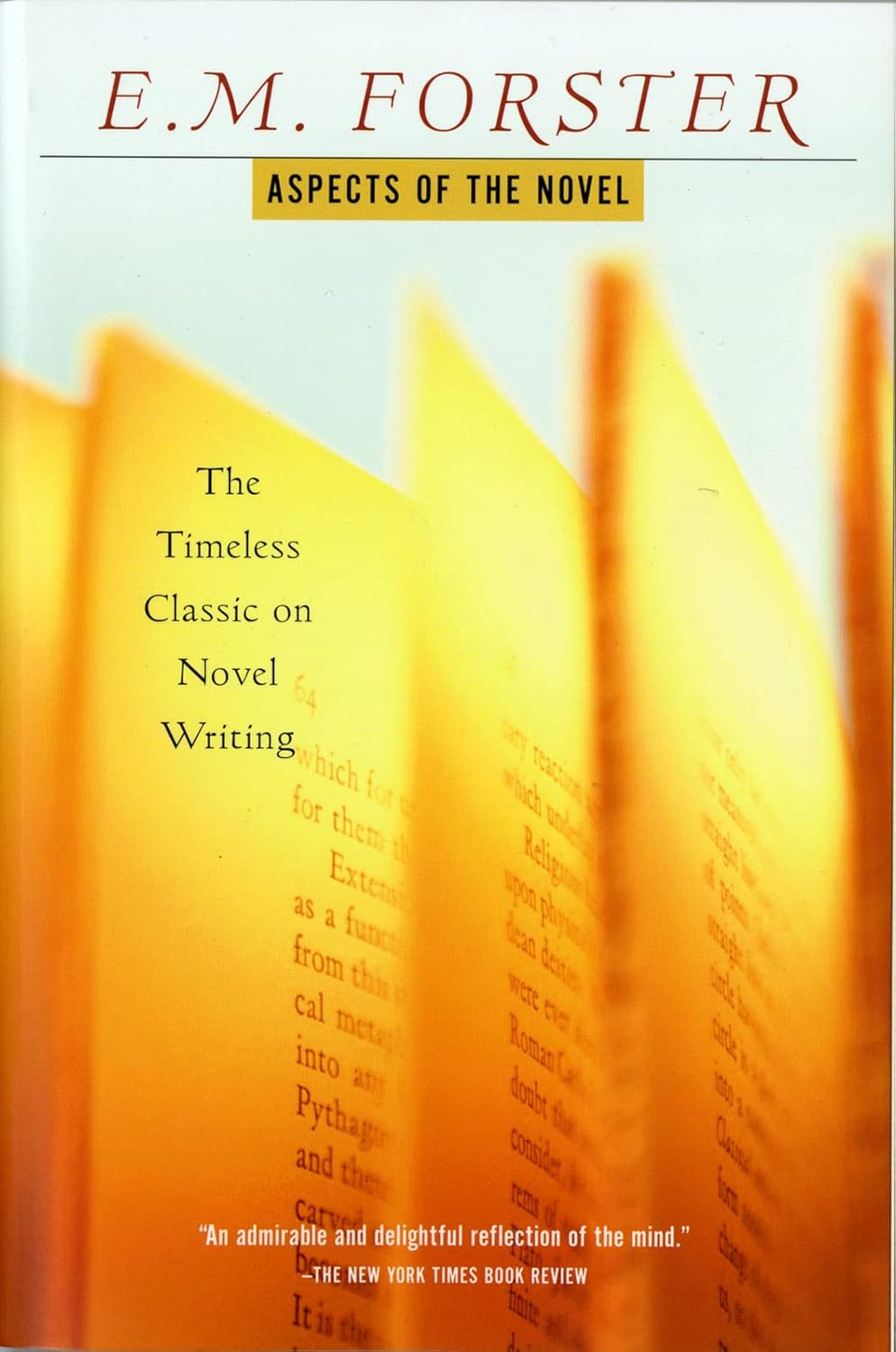
What: A literature lecture given at Trinity College Cambridge in 1927.
Tone: Forester speaks with a warm tone and many contemporary (1920’s) references to an audience of colleagues and students.
Who: You’re up for a challenge or you’d like to feel like an early 20th century Cambridge student for a day.
Read it When: you have a rainy day to fill with checking references every few paragraphs, you feel like having feelings about Story, you like to argue with the dead.
% on Topic: High
After reading a few writing books you start to notice a few names cropping up again and again. By the frequency of references to him, I’d guess that E.M. Forester was assigned in roughly all of the writing programs between 1930 and 1980. I noticed his name in both Delaney’s About Writing and LeGuin’s Steering the Craft, he pops up in Swain’s Techniques and he’s referenced in Roy Peter Clark's Murder Your Darlings. And when many writers whose words I value are referencing the same thing it’s usually an indication that it’s worth checking out.
Picture this, a lecture hall at Trinity College, Cambridge. You sit, your wool suit and shoes damp from the rain, now steaming slightly, shoulder to shoulder with some few dozen men prepared to listen to the first in a series of five annual Clark Lectures in Literature.
Reading Aspects of the Novel you can almost see the dust floating through the air in that lecture hall. It is casual in tone and formal in content. It references Proust as a contemporary (his final book would not be published for another four years). And yet many of the referents are books we are still familiar with today, Austin and Melville, Dostoyevsky and Dickens. And if you have to look a few up, they are worth looking into.
The book was originally six lectures, but is broken into nine chapters including the introduction and conclusion. The sections begin with The Story, move to two chapters on People, then we get The Plot, Fantasy, Prophesy, and finally Pattern and Rhythm. The opening section Story gives us a taste of Forster's style, so I’m going to use the long quote that Delany cites in About Writing to give you that taste.
If you ask one type of man, "What does a novel do?" he will reply placidly: "Well-I don't know it seems a funny sort of question to ask a novel's a novel-well, I don't know-I suppose it kind of tells a story, so to speak." He is quite good-tempered and vague, and probably driving a motor bus at the same time and paying no more atten-tion to literature than it merits. Another man, whom I visualize as on a golf-course, will be aggressive and brisk. He will reply: "What does a novel do? Why, it tells a story of course, and I've no use for it if it didn't. I like a story. Very bad taste on my part, but I like a story. You can take your art, you can take your literature, you can take your music, but give me a good story. And I like a story to be a story, mind, and my wife's the same way." And a third man he says in a sort of drooping regretful voice, "Yes-oh, dear, yes-the novel tells a story." I respect and admire the first speaker. I detest and fear the second. And the third is myself. Yes-oh, dear, yes-the novel tells a story... The more we look at the story (the story that is a story, mind), the more we disentangle it from the finer growth it supports, the less we shall find to admire. It runs like a backbone or may I say a tapeworm, for its beginning and end are arbitrary. It is a narrative of events arranged in their time sequence-dinner coming after breakfast, Tuesday after Monday, decay after death and so on. Qua story, it can only have one merit: that of making the audience wonder what happens next. And conversely it can only have one fault: that of making the audience not want to know what happens next. These are the only two criticisms that can be made on the story that is a story… When we isolate the story like this and hold it out on the forceps-wriggling and interminable, the naked worm of time-it presents an aspect both unlovely and dull. But we have much to learn from it. p. 25-28 Delany’s cut from p.37-39 of About Writing.
Yes-oh, dear, yes-the novel tells a story. There it is. And although you’ve probably just now decided whether this book is for you, or not, I’ll mention a few more things I found remarkable.
Forster’s section on people contains this gem I’ve been thinking about since I read it.
“Even if they [characters in novels] are imperfect or unreal they do not contain any secrets [from the reader].” p.47
He goes on to talk about how novels are the only artform that gives you direct access to the mind of the character. And therefore, the mind of the characters must be there on the page. We are here for their ideas, opinions, and insights as much, if not more than, the plot they are running through. It also contains such a succinct definition of “Flat” and “Round” characters that Roy Peter Clark quoted it directly in Muder Your Darlings.
“The test of a round character is whether it is capable of surprising in a convincing way. If it never surprises, it is flat. If it does not convince, it is flat pretending to be round. It has the incalculability of life about it—life within the pages of a book.” p.78 , cited by Clark on p. 190.
I also very much like his definition of “fantasy” not elves and wizards but simply novels in which something unreal happens. He puts Herman Melville in this category, and Tristam Shandy.
“What does fantasy ask of us? It asks us to pay something extra. It compels us to an adjustment that is different to an adjustment required by a work of art…The other novelists say “Here is something that might occur in your lives,” the fantasist says “Here is something that could not occur.”pg. 108
In his section on Prophesy, Forster is reaching for a definition of what makes some literature truly great.
“Prohpehtic fiction, then, seems to have definite characteristics. It demands humility and the absence of the sense of humor. It reaches back…It is spasmodically realistic. And it gives us the sensation of a song or a sound. It is unlike fantasy because its face is towards unity, whereas fantasy glances about. Also the prophet —one imagines—has gone “off” more completely than the fantasist, he is in a remoter emotional state while he composes.” p.136
He cites only three examples, Dostoyevsky, Melville, D.H. Lawrence, and Emily Brontë. I’m sure we all might name a few more, but that’s part of the point, surely. It’s something you feel only in the reading of the work.
Finally Forster launches into a section on Pattern and Rhythm in prose, which starts with a discussion of plot shapes (hourglass, arc, chain). He says that pattern “appeals to our aesthetic sense, it causes us to see the book as a whole.”p. 151. Meanwhile rhythm is something that runs through the text, appearing like the repeated phrases of a melody in a symphony (his metaphor). He concludes with some thoughts on how the novel might change into the future.
If you’ve made it this far, you should probably go read Aspects of the Novel. It’s slim enough to consume in one or two long-ish sittings but it does not reward quick bites. It is certainly worth the effort though, if in part only because it comes up so gosh darn often in other writer’s works. Aspects of the Novel is not your book if you are looking for quick actionable advice on novel construction. But it might be your book if you are looking to fill a long, slow, rainy afternoon with deep thoughts about novels and characters and why they are important to humanity.
P.S. The Clark Lectures on Topics in Literature are still happening at Trinity College every spring (Since 1888). You can now watch many of them on video.
If you'd like to buy this book based on this review, please consider using this affiliate link here to help support the site.