Tool: Advertency
Unique descriptions are a skill you can build by learning to observe the world around you in detail with focus and compassion.
As I write this I’ve had a cold this week and having a cold is maybe not the thing you want to pay attention to. Nor is having a cold when you are stuck in a train station for several hours. You might instead want to check out, go someplace else, read an absorbing book. But ask yourself, what makes that book so absorbing? Oftentimes it is the deep attention the author has paid to tiny everyday aspects of the universe to put them on the page.
The word I choose to use for this aspect of writing is Advertency. Miriam Webster defines advertant as “giving attention,” but includes a delightful little “did you know?” afterwards:
You may be thinking that advertent should mean "intentional." After all, inadvertent means "unintentional." Take away the negative prefix in- and you're left with that word's opposite, right? If this is your line of thought, you're not entirely off base; the two words (which both entered English in the 17th century and derive from Latin advertere, meaning "to turn the mind or attention") are in fact closely linked. But inadvertent has another, older meaning: "inattentive" or "not focusing the mind on a matter." The established meaning of advertent falls opposite that older sense of inadvertent. Does this mean that advertent never means "intentional"? Not exactly. We have seen some evidence of this use, but it's not yet well enough established to be entered in our dictionaries. (Miram Webster.com)
I often see writers encouraged to observe their surroundings to become better at description. But I rarely see them encouraged to cultivate the attention to the world required to take note of and then recall the unique and interesting things around them that will make for interesting reading.
My conception of advertency began two places. First in the novel Fledgling by Sharon Lee and Steve Miller, in which young Theo Waitly, from an academic culture, has a class in advertency as part of her training. In those books the word carries a weight both of careful observation and an awareness of what is happening around yourself. The word becomes a touchstone for the character throughout the series as she moves from a child’s to an adult’s understanding of the universe.
At the same time as I was reading the Liaden universe books I was being introduced to Zen, a good deal of which has to do with focused advertant attention, during meditation, but also during everyday life. Attention to the self, attention to others, and attention to one’s environment are key points in Zen teachings. This is not a simple awareness of things that are around you, but focused attention on the fine and exacting details of everyday life, deliberate and compassionate.
These two disparate threads have mixed in my mind to make advertency a watchword of my own writing practice. Not just how a place is described, but the unique qalities of both the place and the point of view so that the description cannot be of anything else, or from anyone else. I'm not sure if I've achived that but it is what I'm aiming for.
There is an especially delightful series of skeets by George Penny (@georgepenney.bsky.social) on Bluesky which I think is an especially good example of this. In an ongoing series George describes the goings on at the local community market with humor and compassion:

Not only are these delightful, but they are a prime example of the practice of advertency in the wild. The deliberate noticing of people and events in such a way as to make even the ordinary memorable and distinct. They are exactly how you need to be describing people, places, and things in your novels; not with a generic “she had purple hair and brown eyes,” but with “she walked into the room if not like she owned the place, then at least like she’d rented it for the evening.” (P.S. George recently published a book-length collection of these Tiny Moments of Joy and I'm eagerly awaiting my copy.)
Donald Maas in Writing the Breakout Novel also makes this point in his section on setting “A setting cannot live unless it is observed in its pieces and particulars. A place is the sum of its parts. The emotions that it evokes are most effective when they are specific, better still when they are unique.” p. 97. Unique descriptions are a skill you can build, and the start to building that skill is learning to observe the world around you by staying advertant.
PRACTICE
This is not a unique trait you are born with, but a skill to be cultivated and built over time. So how do we cultivate advertency? Start noticing things. Deliberately build up your attention to the world around you. Here are some places to start:
- Keep a notebook with you at all times. Whenever you are waiting somewhere, write down descriptions of people and the place you are for as long as you can. I had a friend who did this exercise for more than an hour before noticing that the red smudge on the train window next to him was a bloody handprint.
- Go to an art gallery, pick a painting, any painting, and spend at least an hour looking at it. No phones, no audio tour. Just you and the painting and a notebook to jot down your thoughts.This is a classic art history assignment meant to build your observational skills that is also used to help medical students improve their diagnostic skills.
- Write a one paragraph description of a room. Now re-write the description from the pov’s of: Someone who fell in love there. Someone who hates it there. Someone who died there. Someone investigating a murder. An ant who got lost there. Someone just a little too large for the space. Someone walking into the space for the first time. How does each character notice something different?
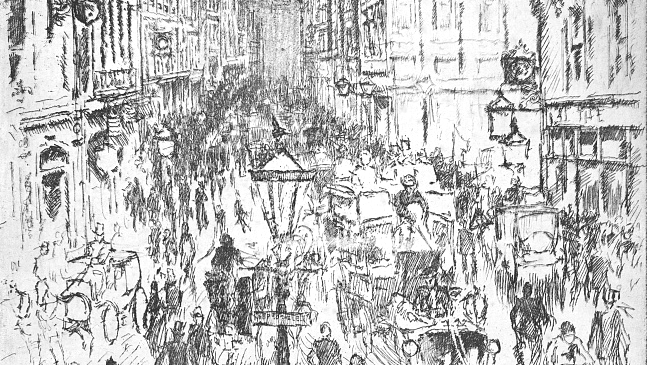
Photo Credit: Via Library of Congress: Pennell, Joseph, Artist. New Oxford Street, London / Jo. Pennell. London England, 1893. Photograph. https://www.loc.gov/item/2003676049/.